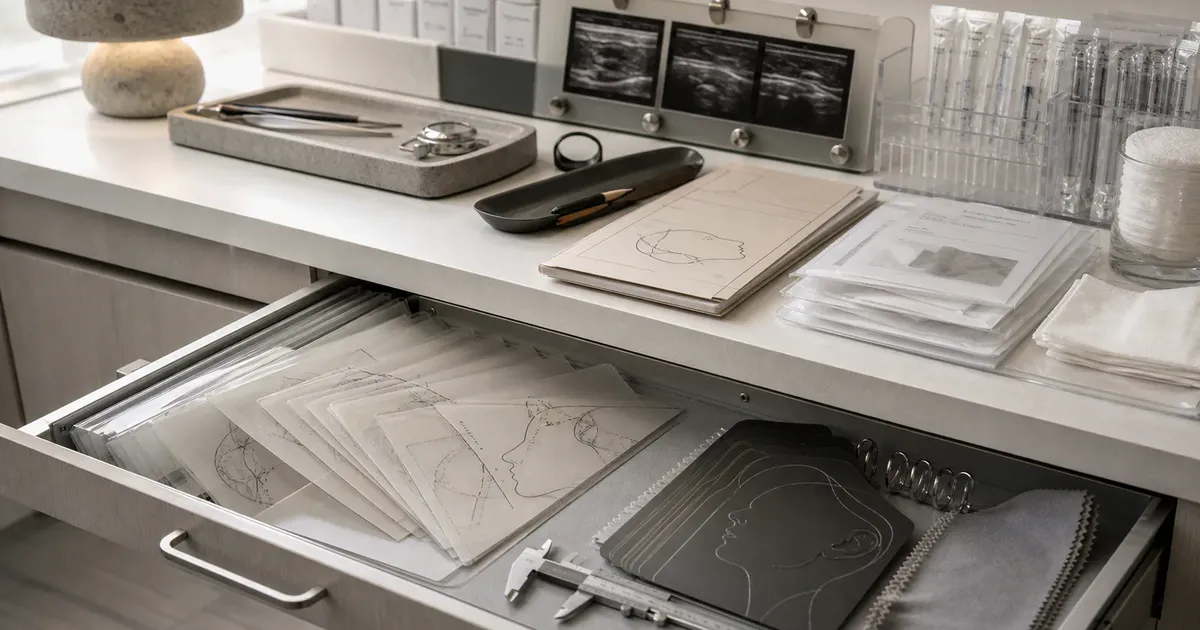
SOCELLE generated image for a report on aesthetic clinic protocol files and disclosure discipline.
Free-tier report
This is the public read. The company intelligence brief goes further.
The public compatibility offer for the $299 Company tearsheet in Report Studio. Wider market, product, talent, and custom questions use the typed report catalog.
$299
one report
One-company operating brief with the decision question and next actions
Company, hiring, and published market context where evidence exists
Source notes, caveats, and a plain-method note for major claims
Private report delivery through the owner-scoped workflow
Scope is confirmed and sources are reviewed before anything is charged.
A fresh aesthetic-medicine pulse points to a practical clinic issue: treatment files now need to explain anatomy, imaging, contour rationale, limits, and disclosure with more discipline than a before-and-after gallery can carry on its own.
Those are not the same procedure story. They sit in different corners of the clinic file: submental evaluation, filler safety, contour restoration, and the way aesthetic concepts are disclosed to patients. Read together, the cluster is less about one treatment gaining attention and more about the operating record that supports treatment choice.
That distinction matters. A clinic can promote a service, but a serious aesthetic practice also has to explain why the service fits the person in front of the provider, what evidence or anatomy is being considered, what alternatives exist, and where the limits are. This pulse puts that work back in view.
Related on SOCELLE
The live market connected to this report.
From the analysis into the live market — the roles hiring now and the companies active in Medspa, straight from the SOCELLE board.
01The July 9 science cluster contains four aesthetic-medicine signals: submental fullness treatment, ultrasound-guided filler safety, calcium hydroxylapatite contour restoration, and neuroaesthetic disclosure.
02Three of the four cluster members were Journal of Cosmetic Dermatology items published through Wiley Online Library.
03The Aesthetics Journal item describes submental fullness as a common aesthetic concern and references an American Society for Dermatologic Surgery consumer survey in its summary.
SOCELLE Intelligence Desk analysis delivered quietly every Monday — the signals that moved, the market reads worth holding, the moves other operators are making.
Free. No spam. Unsubscribe anytime. We use your details per our Privacy Policy and never sell them.
Why it matters for operators
For medspa and aesthetic-clinic operators, the commercial lesson is documentation before promotion. The most valuable asset here is not a new phrase for an ad. It is a treatment file that lets the team answer the same question consistently: why this plan, for this area, with these caveats?
Submental fullness is a useful example because the visible concern can have several possible contributors. A patient may arrive asking about the area under the chin, but the operator still has to separate consultation language from procedure selection. The file should help staff avoid flattening the concern into one default answer. It should capture what was discussed, what was ruled in or out, what the patient was told about limitations, and when the patient should be referred elsewhere or asked to wait.
The ultrasound signal points to a related pressure: safety language is becoming more concrete. Clinics do not need to turn every consultation into a technical lecture, but they do need a way to document when imaging, anatomy mapping, or added caution changes the treatment conversation. That matters for training, consent, practitioner handoffs, and post-treatment review. It also protects the brand from overclaiming. If the proof lives only in a provider's memory, it is weak operational proof.
The contour-restoration item adds a different layer. Contour work is often sold visually, but the operator risk sits in expectation management. A temporal contour conversation, for example, should not be reduced to generic language about looking refreshed. It needs a record of the area being assessed, the material category being discussed, the visual objective, and the caveats around individual variation. That file is what keeps premium positioning from turning into vague promise.
The neuroaesthetics disclosure item is the clearest governance cue. As aesthetic medicine borrows language from perception, emotion, and visual preference, clinics need to make sure patients can tell the difference between explanatory framing and clinical certainty. A concept may help a provider explain why a result feels balanced, but it should not become a claim the clinic cannot substantiate. This is especially important for websites, consult decks, social captions, and staff scripts.
The practical operator move is a protocol review, not a campaign rewrite:
Create separate file sections for anatomy or assessment rationale, consent language, visual objective, caveat, and aftercare expectations.
Mark which procedures require additional imaging, senior review, or documented contraindication checks.
Train front-desk and consult teams to describe evaluation steps without promising a treatment path.
Keep social and website language behind the same disclosure standard used in the room.
Review older before-and-after assets and make sure they do not imply uniform outcomes.
This is also a revenue issue. Higher-trust consultations can support premium pricing because they make the decision feel legible. But trust is not built by adding more medical-sounding copy. It is built when the patient sees that the clinic can explain the work, document the boundary, and decline the wrong case.
What to watch
Through July and August 2026, watch whether aesthetic-medicine coverage keeps pairing injectable and contour topics with imaging, disclosure, and protocol education. If it does, operators should expect the treatment room, the training room, and the marketing review process to move closer together.
The signal is not that every clinic needs to buy a new device or add a new service. The signal is that aesthetic businesses need stronger proof systems around the services they already sell. For more SOCELLE reads on clinic proof and evidence pressure, compare this with the [beauty clinic training-room risk surface](/intelligence/reports/beauty-clinic-training-room-risk-surface) and the broader [aesthetic proof burden](/intelligence/reports/aesthetic-proof-burden-rises-across-lasers-fillers-and-claims).
Prepared with AI assistance by the SOCELLE Intelligence Desk from the publications cited in this report.
SOCELLE publishes market & industry information, not medical, clinical, or professional advice. Always consult a qualified professional before making health, treatment, or business decisions.
Bruce Tyndall— Analyst of Record. 13+ years in beauty and wellness marketing leadership — Estée Lauder, Wella, Kevin Murphy, Naturopathica. Principal Consultant. LinkedIn.