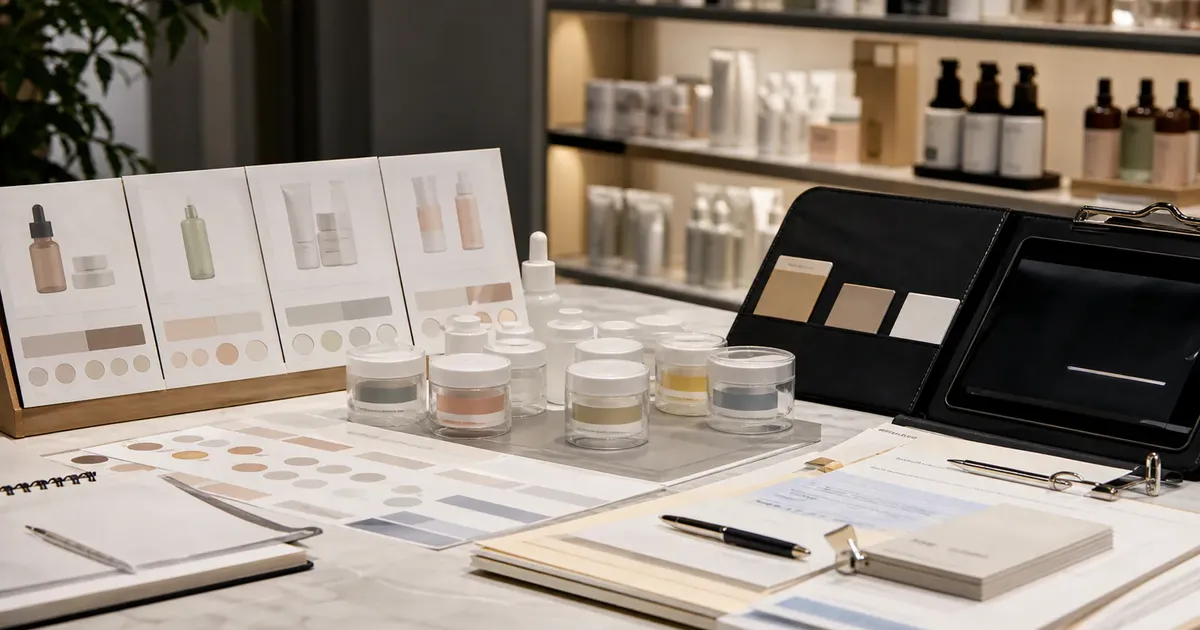
A fresh cluster of beauty signals points to one operating shift: claims, youth marketing, clinic equipment and sustainable formulas now need stronger proof.
Share this report
Send it to a colleague or save the link for later.
SOCELLE visualizes the proof burden moving through beauty retail, clinic sourcing and formula files.
Beauty's latest regulation cluster is not one rule; it is a broader demand that beauty operators prove the channels, devices, claims and formulas they rely on.
The signal arrived from several directions at once. TheIndustry.beauty reported that the UK Government is moving toward restrictions on under-16 access to major social platforms, with implementation expected in spring 2027 if the plan proceeds. Aesthetics Journal surfaced trade concerns around counterfeit clinic equipment and clinic governance. The same publication flagged emerging GLP-1 research with skin-quality relevance. PLOS ONE published a product-development study on apple pomace extract, showing how sustainable product stories still depend on stability data. Business of Fashion's Paloma Elsesser forum coverage sits in the same operator pattern: beauty is being asked to speak more directly about bodies, identity and business responsibility.
What happened
For teen skincare and beauty marketing, the UK proposal would pressure brands that have built discovery around TikTok, Instagram, Snapchat, YouTube and other user-to-user platforms. TheIndustry.beauty notes that teen-focused or teen-adjacent brands such as Indu, Bubble Skincare, Spots & Stripes and P. Louise may need to rely more heavily on parent-facing education, owned content, retail activations, community events and controlled product guidance.
For clinics, the device and governance signals are more immediate. Aesthetics Journal's counterfeit-device coverage points to a practical risk: equipment that looks commercially useful may not carry the sourcing, service, training or documentation a clinic needs if something goes wrong. Its clinic-governance coverage makes the same point from another angle. Policies, incident logs, consent records, escalation routes and role accountability are not decorative admin; they are the operating evidence that separates a mature clinic from a fragile one.
The GLP-1 signal needs restraint. Aesthetics Journal summarized early research on possible skin-ageing implications and wider clinical findings around GLP-1 receptor agonists. For SOCELLE readers, this is market information, not clinical, legal or business advice. The useful operator point is not to make clinical claims. It is to prepare better consultation language, referral boundaries and evidence files as GLP-1-related skin-quality concerns enter consumer vocabulary.
Related on SOCELLE
The live market connected to this report.
From the analysis into the live graph — the roles hiring now and the companies moving in Skincare, straight from the SOCELLE board.
01UK under-16 social restrictions would shift teen beauty education away from open social feeds and toward owned, retail and parent-mediated channels.TheIndustry.beauty reported the proposed UK restriction and named beauty brands that may need parent-facing, owned and retail education paths.
02Clinic operators face operating risk when device sourcing, documentation and governance routines are weak.Aesthetics Journal covered counterfeit device risk and separate clinic governance concerns in the UK aesthetics sector.
03Apple pomace extract can be evaluated in cosmetic formulas through advanced stability methods, but product-development details determine performance.PLOS ONE published stability testing work on topical formulas enriched with apple pomace extract.
Continue from this signal
Connect the report to the market.
Use the topic, hiring, and company paths below to keep moving from the analysis into the public SOCELLE graph.
SOCELLE publishes market & industry information, not medical, clinical, or professional advice. Always consult a qualified professional before making health, treatment, or business decisions.
The intelligence digest
More reads like this, once a week
SOCELLE Intelligence Desk analysis delivered quietly every Monday — the signals that moved, the market reads worth holding, the moves other operators are making.
Free. No spam. Unsubscribe anytime. We use your details per our Privacy Policy and never sell them.
The product-development signal closes the loop. PLOS ONE studied topical formulas using apple pomace extract in cleansing gels, serums and face creams, then compared stability methods across temperature conditions. The operator lesson is simple: upcycled inputs are not credible because they sound sustainable. They become credible when the formula survives the work.
Why it matters for operators
The common thread is proof. Beauty has spent years benefiting from speed: fast social discovery, fast trend cycles, fast service menus, fast product stories. This cluster suggests the next advantage belongs to teams that can move quickly while keeping records strong enough for scrutiny.
A teen skincare brand should now audit its channel dependency. If under-16 access narrows in the UK, the brand still needs demand creation, education and feedback loops. That means product pages written for parents and young consumers, retailer training cards, school-safe or event-safe community formats, careful claims review, and first-party insight programs that do not depend on a public social feed. The best operators will not wait for the final rule. They will build a channel mix that works with or without teen social access.
A clinic should audit its device pathway with the same seriousness it gives revenue reporting. Who approved the device? Where was it purchased? Is the distributor authorized? Are service records current? Is staff training documented? Does the consent language match the procedure being delivered? If the answer lives in someone's memory rather than a retrievable file, the business is carrying hidden risk.
A clinic also needs a GLP-1 language protocol. Consumers may ask whether weight-loss medications changed their face, skin laxity or service plan. Staff should know where the clinic stops, when to refer to a licensed medical professional, and which claims are not appropriate. This protects the patient relationship and the business. It also prevents social content teams from turning early research into overconfident posts.
For product teams, the apple pomace study is a useful reminder that sustainability claims do not replace performance evidence. A founder may love the story of food-waste-derived inputs. A buyer, regulator or sophisticated consumer will still care about stability, preservation, texture, storage and repeatability. Product-development teams should keep the claim file, test method and manufacturing reality connected from the start.
What to watch
Watch the UK timeline before Christmas 2026 and any implementation guidance before spring 2027. If platforms are made responsible for compliance, beauty brands will need to understand which channels remain usable for education, service and community.
Watch whether clinic equipment scrutiny becomes more public. If trade coverage turns into enforcement stories, clinic procurement files will matter more.
Watch GLP-1 language across clinic menus and social posts. The risk is not patient interest; it is operators making clinical-sounding claims without a strong evidence and referral framework.
And watch sustainable product launches for harder proof. The better story is no longer just circularity. It is circularity plus stability, sensory quality and documented performance.
For more operator signals, follow SOCELLE's ongoing intelligence desk at [/intelligence](/intelligence).