This is the public read. The company intelligence brief goes further.
The public compatibility offer for the $299 Company tearsheet in Report Studio. Wider market, product, talent, and custom questions use the typed report catalog.
$299
one report
One-company operating brief with the decision question and next actions
Company, hiring, and published market context where evidence exists
Source notes, caveats, and a plain-method note for major claims
Private report delivery through the owner-scoped workflow
Scope is confirmed and sources are reviewed before anything is charged.
Luxury beauty is becoming a control business: the current signal is not one new jar, one possible retail deal or one makeup launch, but the way packaging, store access and product architecture are being pulled into the same operating question.
What happened
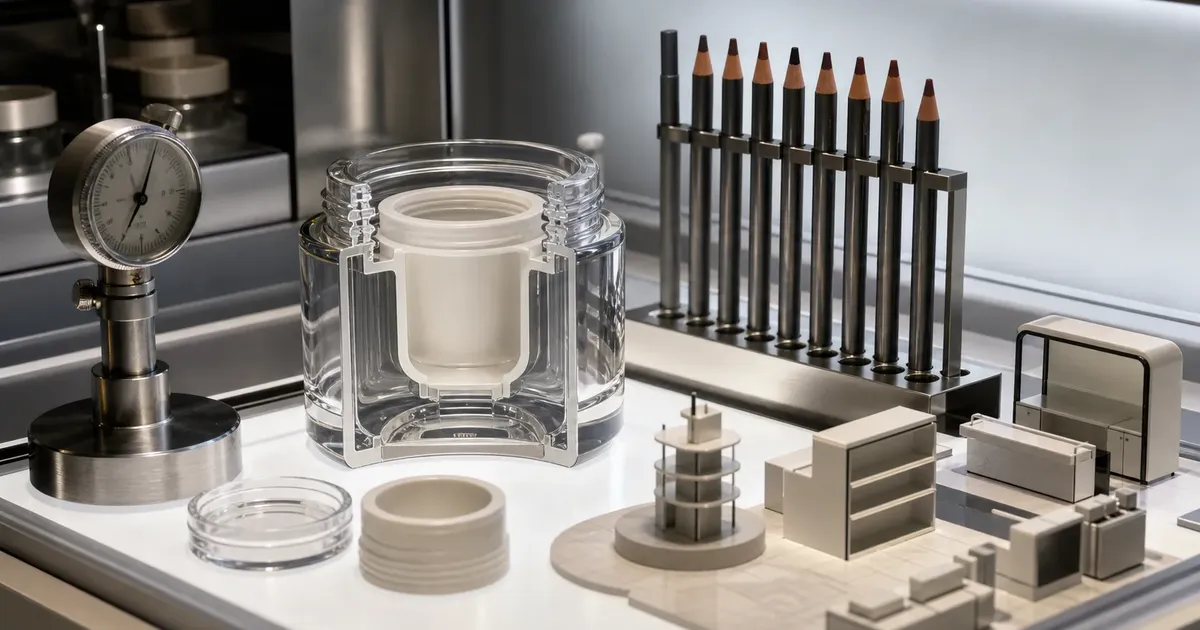
Premium Beauty News reported that Quadpack has updated its Arena refillable jar for prestige and cosmeceutical positioning. The new version keeps the refillable jar concept but moves the outer jar into glass, with a low profile, thick bottom and wide base designed to make the format feel more premium while preserving practical access to the formula.
Global Cosmetics News reported that Next is exploring a potential acquisition of Harvey Nichols, the luxury department-store chain. That story is not only a fashion-retail item. For beauty operators, Harvey Nichols matters because luxury department stores remain high-intent spaces where fragrance, skincare, makeup, service, gifting and clienteling meet.
A second Global Cosmetics News item covered Louis Vuitton's expansion of La Beaute with LV Crayon, the house's first lip liner range under creative director Dame Pat McGrath. The report described the launch as a complement to existing LV Rouge lipsticks and LV Baume lip balms, with a creamy peptide-containing formula, a 10-shade range and monogram-inspired design cues.
Taken together, these stories point to a sharper luxury-beauty pattern. The category is not moving only through bigger launch moments. It is moving through tighter control over the object, the counter, the refill, the shade system, the retail room and the staff explanation that connects them.
Why it matters for operators
For beauty brands, the Quadpack signal is a reminder that packaging is no longer a late-stage wrapper. In premium skincare and cosmeceuticals, the container has to do commercial work: it needs to feel weighty enough for prestige, practical enough for repeated use, clear enough for staff to explain and coherent enough for refill behavior. A refillable jar that feels too light can weaken price perception. A luxury jar that is hard to refill can weaken repeat use. Operators should judge packaging by both shelf impact and operational repeatability.
Evidence and answers
Structured for quick review.
Key claims
01The current brand-news pulse connects prestige packaging, luxury retail ownership and makeup range expansion.
02Louis Vuitton's LV Crayon extends La Beaute into lip liner under Dame Pat McGrath's creative direction.
Continue from this signal
Connect the report to the market.
Use the topic, hiring, and company paths below to keep moving from the analysis into the public SOCELLE graph.
Prepared with AI assistance by the SOCELLE Intelligence Desk from the publications cited in this report.
SOCELLE publishes market & industry information, not medical, clinical, or professional advice. Always consult a qualified professional before making health, treatment, or business decisions.
The intelligence digest
More reads like this, once a week
SOCELLE Intelligence Desk analysis delivered quietly every Monday — the signals that moved, the market reads worth holding, the moves other operators are making.
Free. No spam. Unsubscribe anytime. We use your details per our Privacy Policy and never sell them.
For retailers, the Next and Harvey Nichols signal puts control of the selling environment back in focus. If a major retailer pursues a luxury department-store asset, the relevant beauty question is not simply who owns the building. It is who controls the adjacencies: which brands sit near which services, how beauty is merchandised beside fashion, what data the operator sees, how events are programmed and how clienteling moves between store, digital and appointment-led selling.
That matters for independent beauty operators as well. A spa, clinic, boutique or salon may not control a department-store floor, but it does control its own version of the same system. Where the product sits, how the refill is explained, which mirror or tester moment comes first, and how a service provider hands off to retail all affect whether premium value feels earned.
Louis Vuitton's LV Crayon adds the range-architecture piece. Lip liner is not a giant category headline by itself, but as an extension of a luxury maison's beauty line it creates a different type of operating demand. Staff need to understand shade families, routine pairing, texture, price logic and how a pencil supports lipstick or balm without turning the conversation into generic trend copy. The more expensive or collectible the object feels, the clearer the counter script has to be.
The common operator mistake would be to treat these as separate stories: packaging over here, retail M&A over there, makeup launch somewhere else. The useful read is that luxury beauty increasingly depends on whether the system holds together. A beautiful jar with weak refill education wastes value. A department-store beauty floor without disciplined clienteling becomes traffic without conversion. A makeup range without range logic becomes another display.
For brand teams, this argues for earlier collaboration between packaging, education, merchandising and retail account teams. For retailers, it argues for smaller but sharper assortments where the physical details are teachable. For spas, medspas and salons carrying premium retail, it argues for staff training that connects touch, use, replenishment and service context. Prestige is not only an aesthetic. It is an operating standard.
This is market information, not clinical, legal or business advice. The sources do not prove that luxury beauty demand is rising everywhere. They do show operators where the current discipline is shifting: from isolated premium signals toward controlled premium systems.
What to watch
Watch whether more prestige packaging launches frame refillability through feel and use, not only materials. The next strong signal will be brands pairing refill formats with counter training and replacement cadence.
Watch whether potential department-store ownership changes lead to visible beauty-floor changes: more service programming, stronger fragrance and makeup adjacencies, more private-label or concession control, or clearer digital-to-store clienteling.
Watch Louis Vuitton's next La Beaute steps. If the house keeps building around modular lip, balm, eye and complexion routines, operators should expect more luxury beauty launches to behave like wardrobe architecture rather than one-off color drops.
The practical takeaway is simple: beauty operators should audit the premium experience as a chain. Packaging, shelf placement, staff script, refill path, shade logic and follow-up all need to say the same thing before a luxury price feels controlled rather than merely expensive. For more operator context, see /intelligence (/intelligence) and SOCELLE's recent report on beauty retail brand control (/intelligence/reports/versace-anua-brand-control-beauty-retail).
Bruce Tyndall— Analyst of Record. 13+ years in beauty and wellness marketing leadership — Estée Lauder, Wella, Kevin Murphy, Naturopathica. Principal Consultant. LinkedIn.